Saturday, February 18, 2023

Paris - End Notes

Love locks (this one photographed by Sacre Coeur) are either
 a form of vandalism, or pollution, or a source of income for
the guys who sell them by all the touristy places in Paris.
Maybe all three.

Leaving meta-narratives to the historians and conspiracy theorists, I offer up the following impressions of our trip to Paris.

Life Imitates Art 
A sentimental painting hanging in Musee D'Orsay is me on the day my body told me it didn't care for oysters.


And a Burgher of Calais stands in for the poor woman on the plane home who had to be carried to the First Class cabin she was so sick. This is her on the way back to her seat. 


She had clothes on of course. And she's going to be fine (unlike this fellow).

Accidental Self Portraits

Sometimes you get caught in your own photos, especially with all the reflective surfaces around.

Me, superimposed on a famous Yves Klein statue,
at the Centre Georges Pompidou.

Me reflected in windows going every which way (the lower two panes on the right)
Notice that my top half is pointed one way, my feet another.

Precocious Kid Moment


A three-year-old girl walks into a crowded gallery of Chagall works at the Centre Georges Pompidou. She looks to her right and says to her mother and the forty other grown ups in earshot "Regardez, mamman! Icare!"

Precious Airport Moment

To beguile the waiting at Charles De Gaulle Airport, there's a small installation of the art of Jean Arp and Sophie Taeuber-Arp. This is almost but not quite the most French thing we saw.


Most Ubiquitous Person With A Wide Following
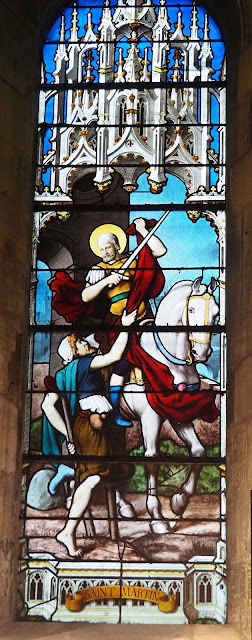
Sylvie, our guide in Tours, told us how she found St. Martin everywhere she went. This stained glass is in the church of St. Sevarin, just across the Seine from Notre Dame.


As for me, the saint I find everywhere I go is Harry Potter.
14 Rue du Commerce, Tours.

Top Three Small Sculptures

In a Tours garden featuring characters from Balzac.
This is Le Pere Goriot. He's not quite three feet tall.

From the decorative arts display at the Musee D'Orsay.
It's less than three inches across.

A sundial by Salvador Dali, 
27 Rue Saint-Jacques, 75005 Paris
Statues with the Best Stride
Charles De Gaulle
Naked Balzac

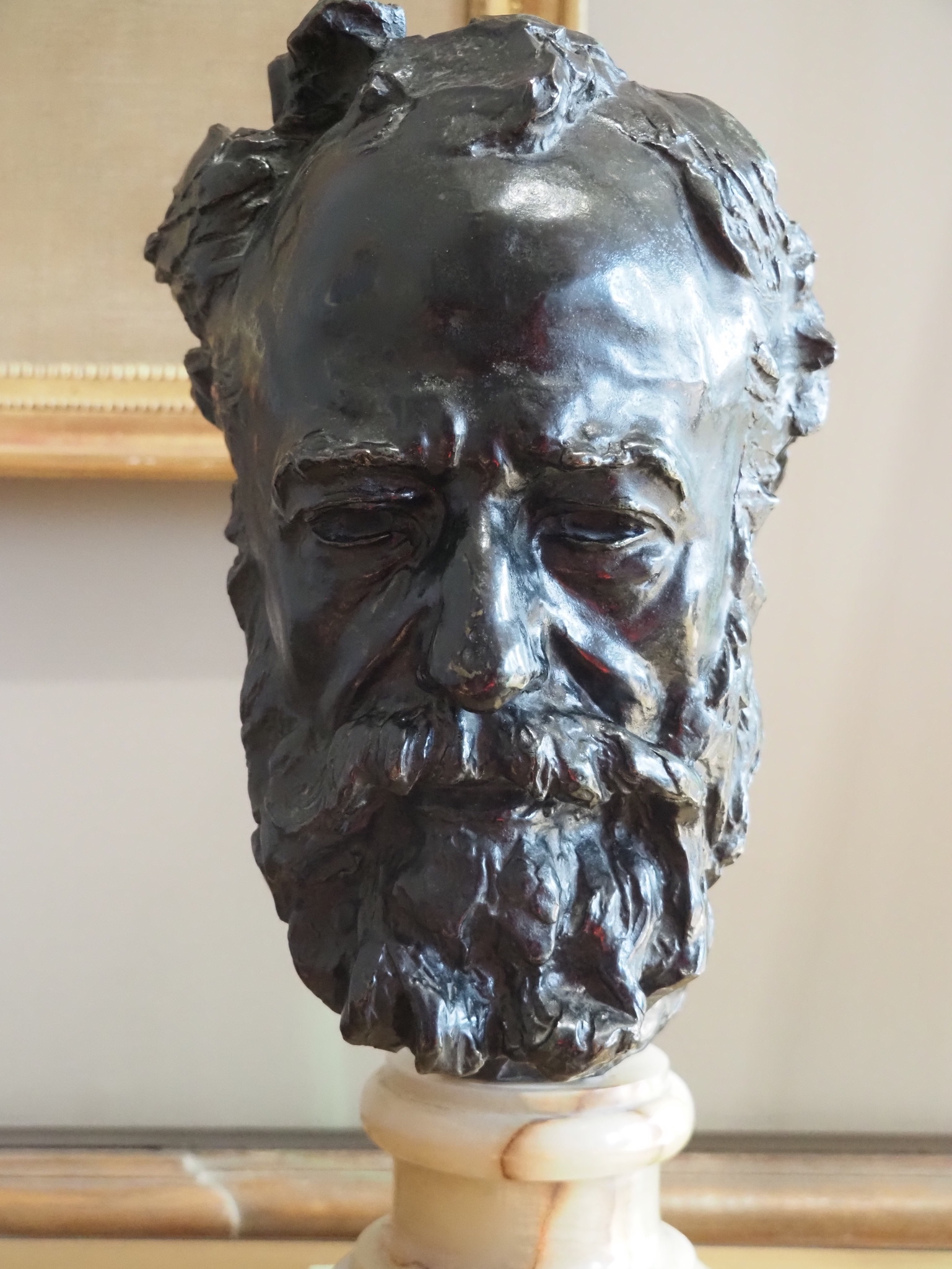
Proof, If You Need It, of the Genius of Rodin's Portraiture (Jack Layton added to show scale)


All of the above made for memorable moments during our visit, but the single most French thing I saw was a road sign mounted on the Basilique Saint Martin in Tours honouring Rene Descartes, topped with a tile graffiti of the Ace of Hearts.


Kind of sums it all up.

Thanks for reading!

Karen

Third: a recreation of Suzanne Valadon's Montmartre studio.

Thursday, February 16, 2023

On Y Va

The Cluny is built on the site of a Roman bath. This picture is from inside the frigidarium.

For our last non-travelling day in Paris, we combined the Medieval finery of the Cluny Museum with the grim but necessary viewing of the Museum of the Liberation of France which features (among many others) the story of Jean Moulin, a senior public servant who helped organize the French Resistance under Charles DeGaulle. Someone betrayed Moulin to the Germans. He was captured, brutally tortured by Klaus Barbie and killed.

So the theme the museums had in common was martyrdom.

We fly out this afternoon. It's another strike day, so we gave ourselves lots of time, caught the last taxi by Pt. de St. Cloud and were at the airport four hours before our flight.

Aside from those hours stretching ahead of us, time has gone by fast in Paris.

Thanks for reading!

Karen

The comparatively low bar for sainthood back in the day. St. Martin cuts his cloak in two to help out a freezing beggar, and St. George vanquishes a garden snail.


Tuesday, February 14, 2023

Really Really?

Of all the astonishing, splendid, amazing things we've seen, which, do you think, would be the single most unexpected one?

Well, obviously, this one:


Whistler's most famous painting, at the Musee D'Orsey of all places, France's biggest public collection of Impressionist (and other) art.

Thanks for reading!

Karen

Oh, plus the third (and counting) 
sighting of Rousseau's Snake Charmer


Monday, February 13, 2023

Paris Pub Crawl

Almost every day, our friend Ed has kindly shared with us his extensive knowledge of Paris.

His special interest is with the writers who hung around Paris in the early 20th Century: James Joyce, Ernest Hemingway, F. Scott Fitzgerald, Arthur Miller, among others.

He can tell you a lot, for example, about where where they drank.


Just so you know.

Thanks for reading!

Karen

Another famous writer.
Not sure where he drank.


Tour of Tours

L'Hotel du Monnaie - 18th C Mint building, 
Our idea was to take the TGV (tres grande vitesse) train somewhere. Judi's much better idea was to take the TGV to Tours and walk around for the day with her friend Sylvie, a retired art history professor and resident of Tours for 40 years.

If you want to know more about Tours, you can find a good description through the link. I'm just going to try to convey the essence of what I picked up.

Over its long history, Tours was important spiritually (it's the resting place of St. Martin), militarily (Joan of Arc came to Tours before launching her campaign to save France), culturally (it was Balzac's birthplace) and politically (it was the capital of France, twice), all of which importance still permeates the place, especially if you have Sylvie showing you around.

Tours got its current name from the Romans, who left traces of their occupation in the form of a huge rampart wall and the foundations of an amphitheatre that could seat 34,000. 

The amphitheatre is gone but the rampart wall is still visible:

Beyond the French hedge, and next to the
Musee des Beaux Arts, the old Roman wall.

Tours' Christian tradition prevailed after the departure of the Romans.

Foundations of a nunnery, from the 10th century.
In the thirteen and fourteenth centuries, grand cathedrals were built (and destroyed).

Cathedral St-Gatien
The next 500 or so years can be summarized by one fine house, the Hotel Gouin:
Hotel Gouin dates back to the 1490s.
 As it looked in the 19th C.
After June 1940, when the Germans bombed Tours
How it looks today
The Loire River brought wealth and commerce to Tours (and flooded a lot in the 19th Century).


There is much more to say about Tours, but I'll stop here. One of these post's appeals is that they are short. And I'm short of time this morning. We're on to the Georges Pompidou Centre, and then a tour of Les Halles.

A bientôt.

Karen