Saturday, February 15, 2020

Authentic - Do Not Touch

Bruce adjusts his vestments outside the
Amsterdam Museum of Bags and Purses
We're still aiming to make the most of our iAmsterdam cards. 

The one important destination today was the Resistance Museum, which remembers the experience of Amsterdam's occupation by the Nazis from May 1940 to May 1945. 

The other destinations were less significant, but scratched an itch I've had since we glimpsed the staggering wealth of Amsterdam's upper classes at the Rijksmuseum. I've been wondering how they lived.

Our first destination was the Amsterdam Museum of Handbags and Purses. It's a handbag version of the Gardiner Ceramic Museum, in that it is basically an extensive personal collection on display to the public. 

What's impressive about the collection is the building the collection is housed in at Herengracht 573. Herengracht was the canal address of the city's super wealthy. If you were a merchant or a craftsman and you were doing well, you could buy a lot and build a house three windows wide. If you were even more wealthy, say a banker or a mayor, you could buy two lots and build a house five windows wide....

Herengracht 573 is a five window wide property that no one has lived in since the turn of the last century. For a hundred years, corporations used the address for their fancy offices. Then, in 2007, an anonymous benefactor bought the house (our conservative guess is 5 million euros) to serve as a space to display the personal collection of two brothers who had a thing for handbags. 

I'm not making this up.

Photographs were not allowed in the collection, so you'll have to take my word that the space, dominated by a spectacular central staircase, was really something.

Next destination, just down the canal from 573 was the Willet-Holthuysen Museum at Herengracht 605. We didn't know anything about this place; it had not shown up in my research, but, when we walked by it, we figured we needed to go in.

Another five-window wide fine old home, the point of this museum is to show how rich people lived in Amsterdam.


From the second-storey window: the garden.
They lived well, surrounded by all their stuff, with secret passageways to avoid the servants. And sufficient wall space to hang huge pictures like those we saw at the 17th C Portraiture show at the Hermitage Amsterdam.

The Willet-Holthuysen Museum is roughly analogous to the Frick Museum in New York City, in that it is a family home full of the things the former owner thought precious. The big difference between the two is while the Frick contains some of the world's greatest masterpieces of Renaissance, Dutch and Baroque painting, the Willet-Holthuysen, not so much.  The childless couple who owned the home both came from money and married when they were in their late 30's. They lived bon vivant lives, their love of the arts fuelled, evidently, by pedestrian taste.

The Museum of the Resistance is, oddly enough, another five-window-wide former abode, but this time the address is less interesting than what's inside.


What this card says: of the estimated 140,000 Jews in the Netherlands, 107,000 were shipped off to work camps. Of those people, 5,300 survived. An estimated 25,000 went into hiding; of those people, 18,000 survived. According to the museum narrative, at the time, people wondered which path would provide the better chance of survival. In hindsight, the choice is clear.


Thanks for reading!

Karen

Scattered around
Amsterdam
social housing projects:
worm hotels

By the Amsterdam School: the Grand Hotel Amrath


Grand Hotel Amrath
May also include worms: green roof on a house boat.


Friday, February 14, 2020

Our Money's Worth

To not put too fine a point on it, we paid 125 euros, each, for a five day iAmsterdam card. That means we have to use our cards to ride the transit/enter museums to the tune of 25 Euros a day to break even. Because we are retired people, we take this challenge very, very seriously.

We're doing fine. Today for example, we took a "free" canal tour, and here's a selfie to prove it:


Then we swung by the Botanical Gardens, affording me my first and perhaps only opportunity to compare Amsterdam unfavourably to Edinburgh:


Next stop, the Hermitage Amsterdam, where we saw "Jewels" a collection of over-the-top opulence somehow rescued from the Romanov court. 


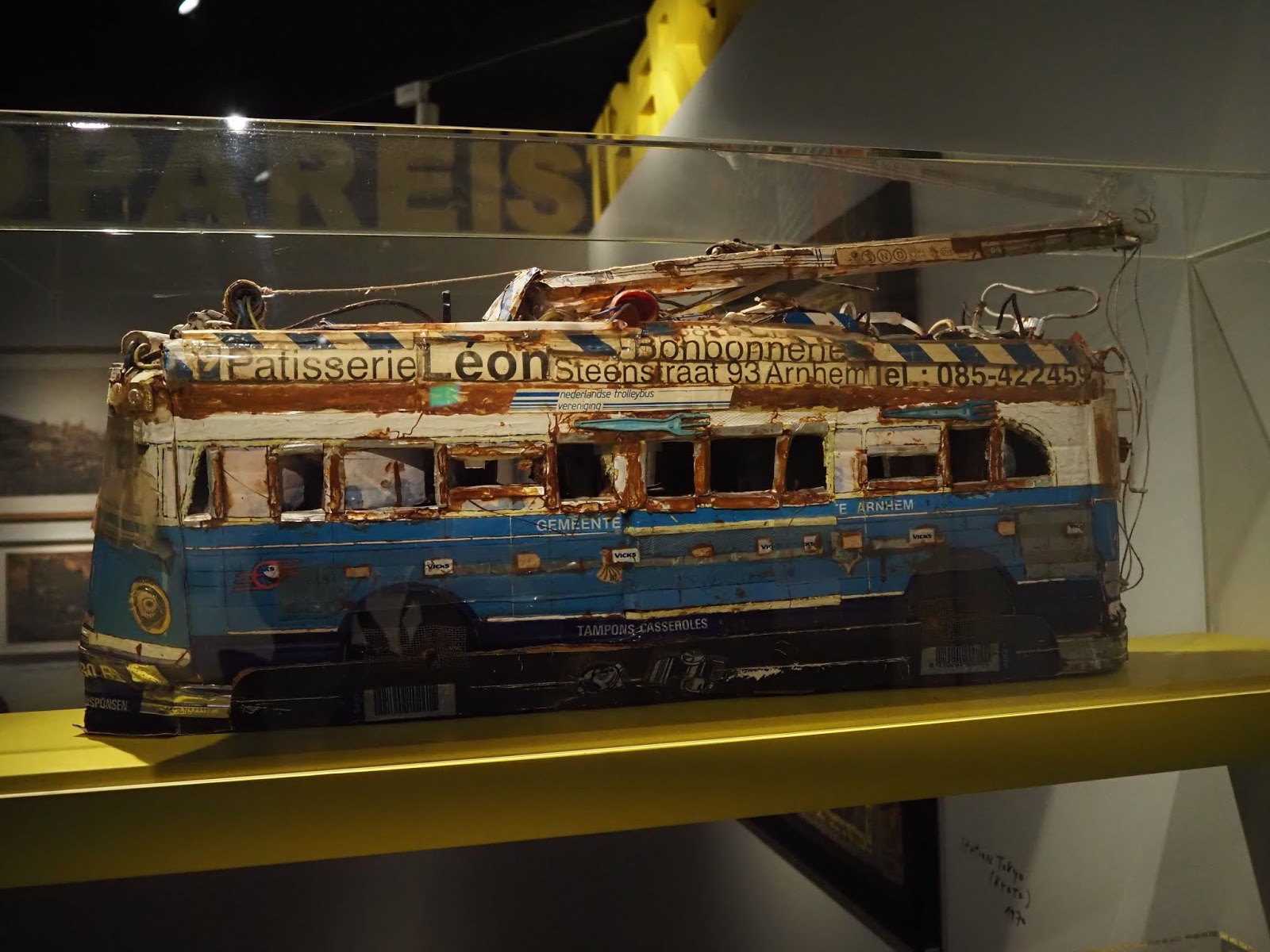
And we saw "Outsider Art", the pictorial and sculptural ravings of Willem van Genk (1927-2005), who, if he wasn't a schizophrenic, sure painted and wrote like one.

Then we took in the Hermitage's third major show, Portraiture of the 17th C.


That was enough for one day, but, because it was on the way, we also took a spin through the red light district, just to see what it was like and what all the fuss was about.


I learned that the street lights are in fact painted red (you can see one in the shot above) and the sex workers really do stand in the windows posing suggestively for passers by. Nothing on offer was covered by our iAmsterdam cards.

Note, however, that the afternoon was actually sunny, and that, when you're on holiday, is something money can't buy.

Thanks for reading!

Karen


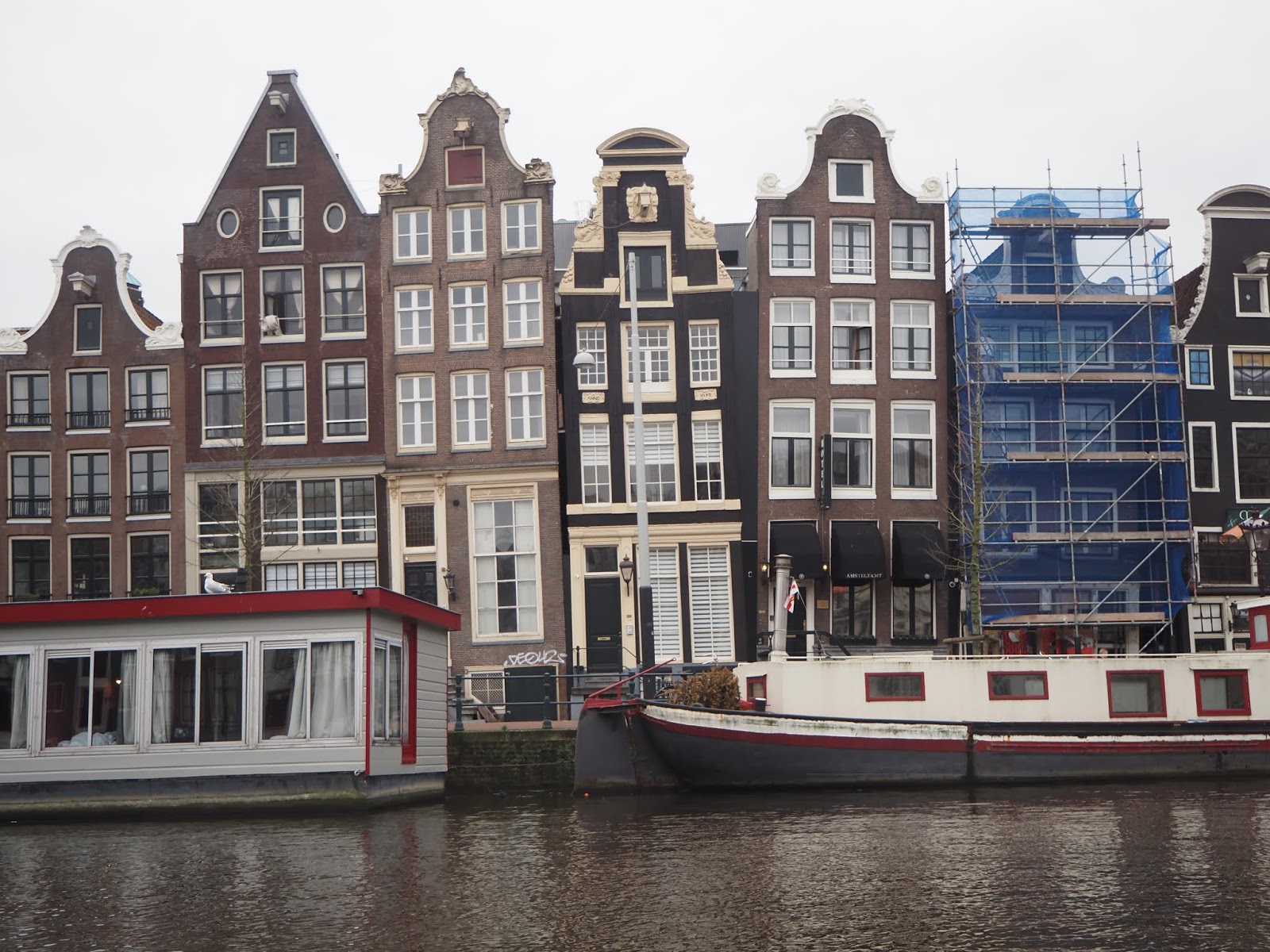
Off-perpendicular canal houses. 

Miniature street cars through
the lens of serious mental illness.


Thursday, February 13, 2020

Rain Day

The weather was certifiably filthy today: high winds and pelting rain for most of the morning. We had early tickets for the Van Gogh Museum, so we hopped on the BGV, where Amsterdammers greet their tram conductor like an old friend, and spent the morning indoors enjoying the show before the hordes arrived.


The original plan for the day was to go to Hermitage Amsterdam after the Van Gogh, but the transit connections weren't great, so there'd be a lot of walking to get there, and the weather was still just awful. Bruce had the bright idea to go instead to the Stedelijk Museum of Modern Art, which was literally right next door. 

There we found an on-the-nose artwork on display:


That's a neon sculpture, made in 1969 by a man named Bruce, entitled "My Name If It Were On The Moon." 

My lower back was getting sore by the time we started our third hour of museum viewing at the Stedelijk, which may be why I felt disengaged from the pieces on display. Or it could be that visual art after 1950 just makes me angry.


Doesn't make me angry: Mondrian circa 1929
After lunch, the weather cleared up so it was safe to go outdoors. It was not, however, safe to walk too close to puddles on the street, which passing vehicles turned into spectacular ten-foot-high plumes of filthy water. 

We walked for about an hour to go see the "Het Schip" - an "Amsterdam School" designed workers' housing project - so-called by the locals because, well, it looks like a ship.

The Amsterdam School is a little bit Arts and Crafts movement, a little bit Art Deco, and a little socialist sentimental. They designed buildings and things so as to elevate common objects and make them beautiful for working folks. Some of these pretty objects were on display in the Het Schip Museum. 


So you can see why it got called a ship.

Decorated glass lamp, from below and from the side.


A clock.

A Fireplace screen.


 Another clock.

It's just one of life's little ironies that most of the beautiful things the Amsterdam School made were too intricate to mass produce, so it was mostly only rich people who could have the stuff they made. But, Het Schip itself is still a low income housing project and regular people live there even now.

Exterior: Het Schip.

Detail: Het Schip decoration
Thanks for reading!

Karen

PS - A note on the Van Gogh Museum - it is exceptionally fine.  Its focus is on Van Gogh as an artist - not just the multi-million-dollar canvases, not just the guy who cut off his ear ... I consider myself to be pretty knowledgeable about Van Gogh, but I learned a lot today ... and when the story got to where he descended into madness, it was inexpressibly sad. 


Wednesday, February 12, 2020

Getting the Gist

Bruce at the MOCO - not Banksy, not Koons, but just as cool.
We like to get the flavour of a place when we travel. That's why we like to wander around rather than ride the transit. And why we try to find a balance between the touristy parts of town and all the other parts.

That said, after we got our iAmsterdam cards this morning, we took a direct route to the Rijksmuseum because I was going to see those Rembrandts and Vermeers, dammit.

And I wasn't disappointed. 


Art History Major Dream Come True: Detail from The Night Watch by Rembrandt

The reason we are travelling in February is to avoid some of the worst of the crowds. This appears to have worked. The crowds in the Rijksmuseum were small and well-behaved. Better than the AGO on a Sunday afternoon. 

The Rijksmuseum is an amazing collection, showing on a scale I had never imagined the wealth of the region in its mercantilist heyday; it makes the Scottish Renaissance look like a yard sale.

Outside the grand museum, the city impressed us in other ways:


Toronto tells you to keep your dog off of gardens and boulevards and yards. Amsterdam shows you where your dog can go.


Cultural appropriation looks different in A'dam.


Bike parking by the central train station.
We had heard about the bikes. We had seen pictures of the bikes, but nothing really prepared us for the ubiquity, intensity and sheer number of bikes.

We had heard about the cannabis shops but nothing really prepared us for their ubiquity. The sign below provides a guide to the intensity.


Every once in a while, our tendency to just wander brings us in the vicinity of a touristy spot, which is how we ended up in the Flower Market.


And, after three hours in the Rijksmuseum, we were hungry enough to risk some local cuisine again. This time it was pea soup (a local mainstay) and fries (just because) at the Cobra Cafe right outside the Rijksmuseum. If you go to Amsterdam and decide to try this, don't bother to order the fries. The pea soup is delicious and all you need.


Thanks for reading!

Karen


Banksy at the MOCO.


Also at the Flower Market.


Self portrait with bourgeois porcelain overkill.

Tuesday, February 11, 2020

About 18 Hours Ago As I Write

Bruce breaks in the hotel bed.

Bruce breaks in the hotel couch.
About eighteen hours ago as I write, we were wedged deep in the cheap seats of a 25-year-old Boeing 747, operated by KLM, waiting for take off so we could fly to Amsterdam.

The tail winds over the Atlantic were mighty, though, unlike two nights before, we didn't break any speed records.

We were, however, almost a full hour ahead of schedule, which meant we spent almost 60 minutes less than we might have otherwise packed like sleepless sardines in the belly of the giant plane.

I don't think I've ever flown before on a 747. If I have I've forgotten. I could not get over how huge it was. Especially since we got such a tiny share of its massive footprint.

Anyway. We arrived sleep deprived, but our karma paid out in other ways. Our room at the Yays Bickersgracht Concierge hotel was ready for us to settle in when we arrived at 8:30 a.m. So settle we did, until about 2 this afternoon.

Then we headed out to find some groceries (we have a full kitchen in our 2-bedroom suite) and experience the local colour.

So of course we ended up in a charming, ancient (established 1733), hole-in-the-wall "brown bar" called De Blauwe Druif (the blue grapes), not the oldest bar in Amsterdam, but certainly the oldest in the 'hood.

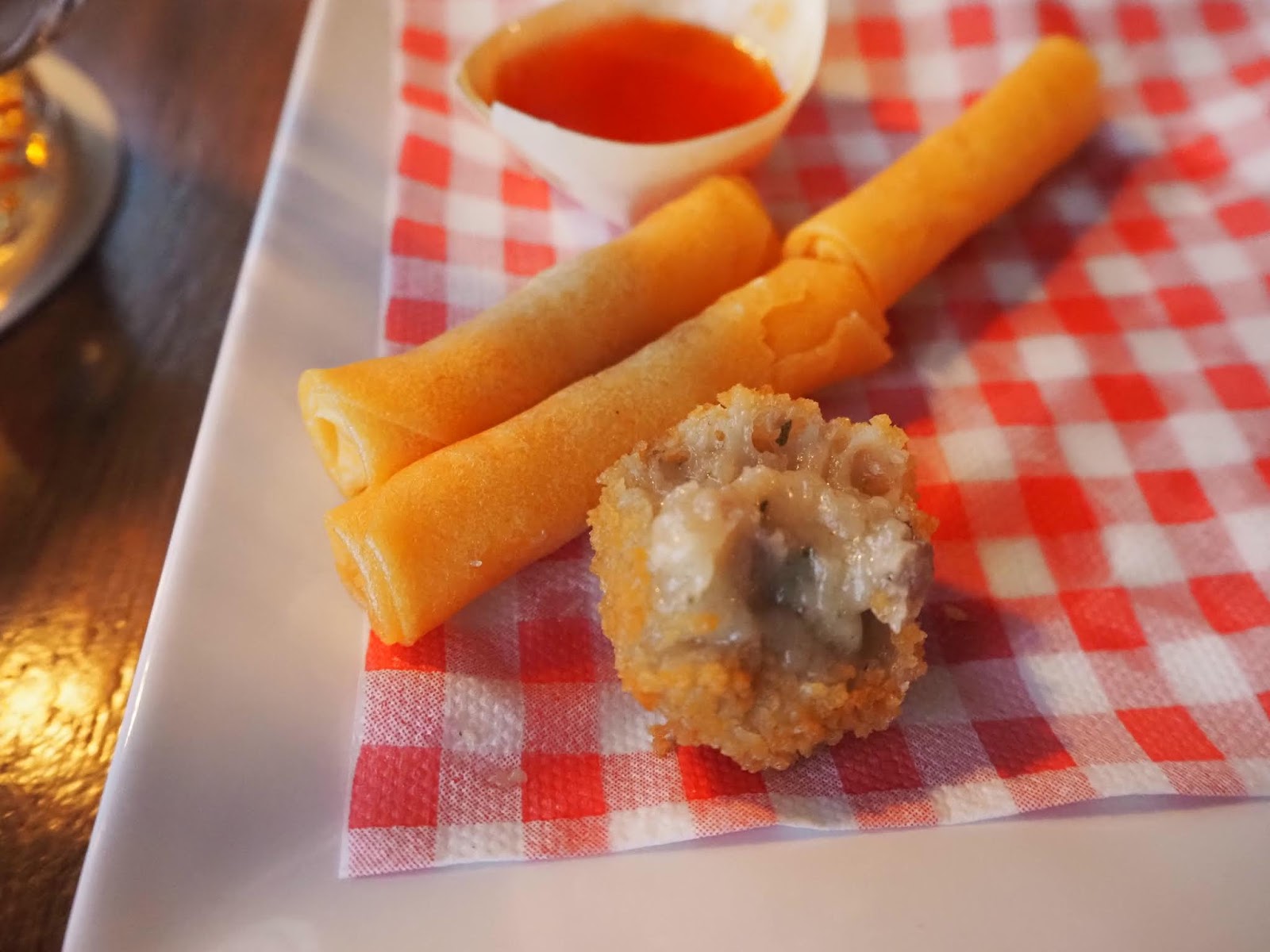
We were thirsty. To fix that was easy: "Heineken please." We were also hungry. We asked the server for his recommendation. He said: "Try the bitterballen and the cheese fingers."

So we did. Because, Rome.


The "bitterballen" are billed as beef croquettes. The cheese fingers are billed as, well, cheese fingers.

If it were my job to come up with more descriptive names for these snacks, I would call the cheese fingers "kraft process cheese spring rolls" (doesn't that sound delicious), and the beef croquettes would be "mucous balls in crispy breadcrumbs."

We of course ate every bite of these authentic local dishes, just like we ate every bite of the haggis we tried on our first day in Edinburgh. But that's it for the colourful local cuisine for me.


Ick. Ugh. Gag.

But the beer was good.

Thanks for reading!

Karen


Upside down poker game
on the ceiling of De Blauwe Druif 


Saturday, February 8, 2020

Tourists of the Anthropocene

Before there were selfies: Bruce and I interact with life-size, 3-D reproductions of famous Impressionist paintings, May 2007, Grounds for Sculpture, Hamilton, New Jersey
Last night, Bruce and I saw Douglas Coupland live and in person onstage at the recently reopened Paradise Theatre.

Coupland was in conversation with someone insufficiently famous to have his name on the playbill, so I can't tell you who he was. I can, however, tell you what he was along with being Coupland's #1 fan. He was a professor of something or other, was intimately acquainted with every iota of Coupland's corpus and played the very essence of the fawning academic. 

Coupland's appearance was to help promote his show "Fordite: Neominerology in the Anthropocene" which plays on how layers of old car paint mined from decommissioned vehicle manufacturing plants have been turned into a modern gem stone.

As interesting as Coupland's work can be sometimes, there is nothing less stimulating than two rumple-dressed middle-aged white guys sharing their own special language about Coupland's fixation with the objects of the modern age and how their persistence in the environment articulates with pathos, humour and horror the dilemma of the human condition.

It was a well-spent hour, but I was starting to nod off at the end.

On Monday, we are off to Amsterdam where the temperatures are in the lowest double digits and the rain forecast hovers around 40% for every day we're there.

Thanks for reading!

Have a great week!

Karen


Saturday, February 1, 2020

Stuff Never Sleeps


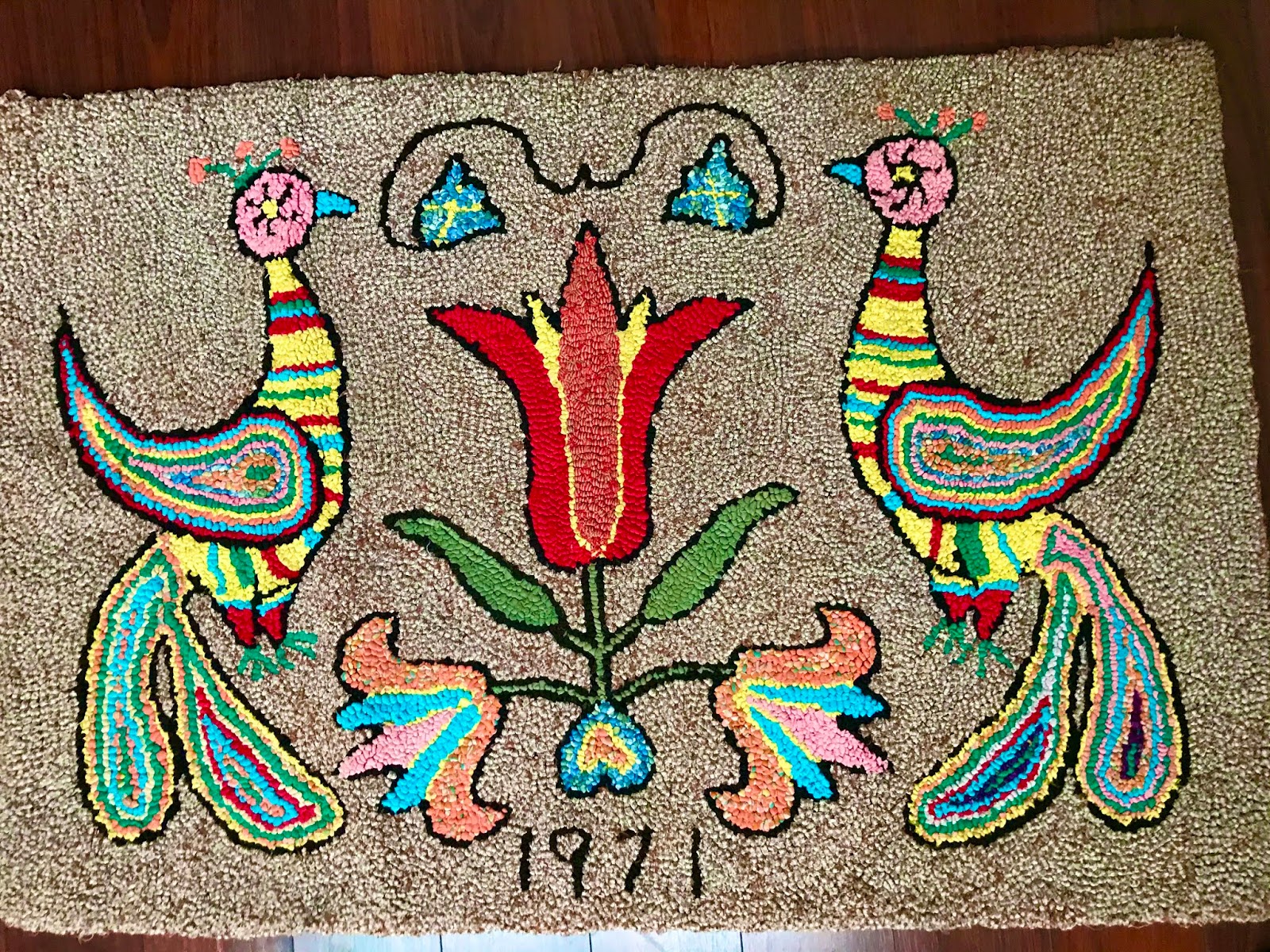
Still sparking joy: hand hooked rag rugs, a product of the genius and hard work of the Mills/Clarke/Brown women.

A couple of posts back I mentioned that Bruce's dad would move this month from "independent living" on the 15th floor of New Horizons Tower (NHT) to "supported care living" on the 2nd floor. This was exactly the right thing to do at exactly the right time.

Bruce's dad moved his body down thirteen floors to his new smaller, sparer room without any fuss. All that was left for us to do was figure out what to do with Ken's stuff on the 15th floor.

The guy who helped us move Ken into NHT had admired Ken's 60's vintage coffee table and end tables. So, this past week, Bruce got in touch with the guy to say he could have 'em if he wanted 'em. He did.

Those pieces taken care of, all we had left was a bed, a double width mirrored dresser, a night table, three arm chairs, an occasional table, a cedar chest, an old-style phonograph stand, a thirteen-year-old Samsung TV, five table lamps, twelve pairs of shoes, four tv tray tables, a walker that was too short for Ken to use, several small appliances, four table settings' worth of dishes, two large closets full of clothes, a strong box full of documents and a laundry basket stuffed with photo albums, genealogical information and mementos collected by Bruce's mom.

We sorted through the closets, pulled out what Ken needed and could still fit into (he's put on a little weight since he moved to NHT), put anything too worn into garbage bags and took the rest to the Salvation Army Thrift Store. We made several trips to the Sally Ann that day. 

One chair, one table lamp and the occasional table went into Ken's new room.

We didn't need any of the remaining stuff -- which NHT would put on the curb to be taken away as large garbage -- but took home the cedar chest and the phonograph stand anyway. Bruce thought the laundry basket of memorabilia would have to go with Ken to the 2nd floor, but I said no, there's no room. We took that, too.

We cracked open the cedar chest and found three hand-stitched quilts and the two rugs in the photos above. I put the memorabilia into proper boxes to protect them from dust and sunlight and ... placed the boxes in the crawl space I'd just emptied of similar stuff.

Thanks for reading!

Have a great week!

Karen


1956 valentine from Ken Clarke 
to his sweetheart Marna Mills